Ruined & Abandoned
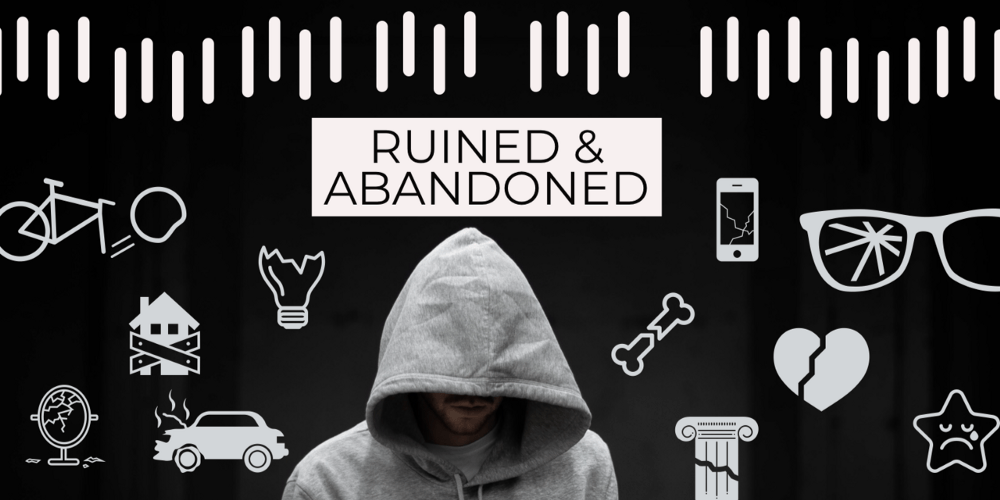
We all run into the issue of feeling broken , not being able to see value in ourselves. We may feel like there is no other way of experiencing life. Or even wanting to feel numb, not wanting feelings altogether. Feeling worthless, seeing limitations in life, feeling without option. These thoughts and feelings are not new. Some of the most renowned individuals have experienced feelings of ruin and abandonment.
Those closest to President Abraham Lincoln described him to exhibit profound sadness and even suicidal thoughts, labeling it as “melancholy.” He would at times experience anxiety attacks.
Vincent Van Gogh was reported to have unstable moods and suffered from recurrent psychotic episodes.
Charles Darwin very seldom left home and lived as a recluse.
Charles Dickens was believed to have suffered from severe depression.
Winston Churchill named his depression the “black dog”. He would experience bouts of reoccurring depression.
It’s truly astonishing how mental health continues to hold a stigma. We continue to be shocked at the horrors of our communities. Shootings, drugs, abuse, suicide, all of these things continue to occur and statistically rise yet we find difficulty in collectively addressing the issues until they become epidemics.
For those of us that get it, and see mental health as something to manage, process and appreciate, here are a few considerations in times of struggle.
- Remember, the body goes through a chemical change on average every 15- 30 minutes. It regulates and processes fluctuations. Ps, that’s why breathing helps.
- Thoughts we have during these times of high chemical imbalances come from distortions, not full truthful realities about one’s self. It’s important to trust something external and larger than one’s self during these times. Having these anchors of truth keep our identity grounded.
- Experience or discomfort of spatial and mental singularity (loneliness) tends to leave us feeling hopeless/ helpless. When we run into this, try to think back as early as your grade school. What have been areas of life that you have mastered? Reflection of the skills you’ve mastered and people you have connected with will naturally bring a balance to feeling isolated. It could also provide a meaningful sense of awareness to skills you may still need to attain. Reviewing Erickson’s stages of psychosocial development can be a great way to filter and assess one’s own virtues and lackings.
- During these times, we may witness our support system begin to break down. People who we always felt we could trust might not surface when you need them most. If that’s the case, vilifying them won’t make matters any better. Starting from grace always gives us a sensible and wise path. We can develop and explore a larger support system. Doing this will test our resourcefulness and strengthen our decision-making skills.
“Find meaning. Distinguish melancholy from sadness. Go out for a walk. It doesn’t have to be a romantic walk in the park, spring at its most spectacular moment, flowers and smells and outstanding poetical imagery smoothly transferring you into another world. It doesn’t have to be a walk during which you’ll have multiple life epiphanies and discover meanings no other brain ever managed to encounter. Do not be afraid of spending quality time by yourself. Find meaning or don’t find meaning but ‘steal’ some time and give it freely and exclusively to your own self. Opt for privacy and solitude. That doesn’t make you antisocial or cause you to reject the rest of the world. But you need to breathe. And you need to be.”
-Albert Camus
While these may be great options and steps, they do not take away the fact that you must walk through it, because ignoring it doesn’t work. Ignoring opportunities for growth and battling internal opposition is what truly destroys us. Apathy is a silent assassin.
I recall a trip where I visited ruins of ancient churches . Churches listed in the Bible, in Revelation. Driving or walking past these sites, you wouldn’t have known they were of any importance. Some were more off the beaten path than others.
These ruins had commonality . Although they each may have had their unique origin stories, had families and leaders, and even generations of stories, they all ended up looking the same. They were all in ruin. They were all abandoned. They were in a state of rubble, laid to waste.
I’ve never been a believer of coincidence. I believe patterns and experiences occur for purposeful reasons. Seeing this rubble was a physical representation of humanity. Showing how iterations of us continue to grow from older versions of ourselves. While our bodies may feel broken, our spirit can continue our story. In times when our spirit may feel pained, our mind can persevere. If our mind is in confusion, our heart can lead the way. We adapt, we grow.
In the realm of developmental psychology , Lev Vygotsky is a name that is studied frequently. Vygotsky defined a theory of cognitive development stressing the role of instruction and guidance. Lev coined the phrase “Zone of proximal development”. This is a cognitive range between what a child can do on their own and what they can do with the help of adults or others more skilled than themselves.
This theory holds a presupposition . It assumes a range between what we can do on our own, and what we’re capable of doing with the help of others. If we isolate our existence; meaning if we isolate how our life balances itself, we do not give it the opportunity to strengthen.
Lies that tell us we are inferior when we struggle , or that our identity is “wicked” and thus worthless when we don’t live up to standards, these distortions keep us limited. They keep us in a controlled environment.
The truth is, in any single situation there exists thousands of realities and perspectives. Experiencing them (or allowing our mind to accept them) is a matter of choice, pure raw and unconditional choice. Having resources, support, and access to choice provides freedom.
Geries Shaheen is a Licensed Professional Counselor and Nationally Certified Counselor operating in and around St. Louis Missouri. Adjunct Psych professor at Saint Louis Christian College. Quality Management Specialist at Preferred Family Healthcare. Geries holds his MA in Professional Counseling from Lindenwood University, BA in Intercultural Studies from Lincoln Christian University, and holds a certificate in Life Coaching, Geries provides life coaching services to clients online globally
Pioneer Counseling Blog